|

|
D-lab India
Team Leader
Sam Davies,
sdavies@mit.edu
Past Projects
(D-lab 2003-2004)
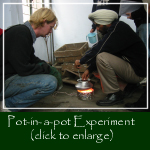
"Pot-in-a-pot"
Refrigeration
Mohammed Bah
Abba, a Nigerian teacher, invented a simple way to keep vegetables
cool by using the power of evaporation. The basic idea is that a
smaller earthenware pot in nestled within another pot, and the space
in between is filled with sand and water. When that water evaporates,
it pulls heat from the interior of the smaller pot. It is in this
cool area that vegetables and fruits are kept. Even though the system
only provides a few degrees of cooling, that's enough to extend
the life of produce dramatically (according to Abba's experiments,
eggplants stayed fresh for 27 days instead of three, and tomatoes
and peppers lasted for more than three weeks). Students in this
past year's D-lab class tested the performance of Abba's invention
in addition to testing their own improvements to it. In January
and June 2004, the India D-lab group tested the pot-in-a-pot refrigeration
system in India, but because India has a relatively high humidity,
the technology did not function as well as expected. The students
are currently working on improvements that could overcome this problem.
Paddy Straw
and Dung Charcoal
The D-lab India
group broadened the reach of the technology developed by Amy Smith
and members of the previous D-lab class by which sugarcane is transformed
into cooking charcoal (see Haiti
section). Instead of sugarcane as the basic ingredient, they used
rice paddy straw, which is similar to hay. In addition, instead
of using cassava flour to bind the charcoal together, as the previous
D-lab group chose to do, the D-lab 2003-2004 India group used cow
dung. While these new materials seemed to be better suited to India
than the materials chosen for Haiti, they also presented an entire
new set of obstacles to overcome. During a recent trip during Summer
2004, the group overcame most of those obstacles,
Inexpensive
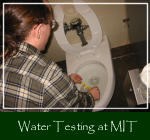
Water Testing
By building upon
an invention by Instructor Amy Smith, students taking last year's
D-lab class brought a technology for cheaply test drinking water
in developing countries significantly closer to a finished, workable
product. Instead of costing around US$1000, as most water testing
apparata do, the water testing system designed in D-lab costs less
than US$20. The D-lab India team took prototypes of the water testing
system to sites around India, and preliminary data have shown that
the system works. Last year's Honduras
D-lab team also worked on testing and developing this water testing
technology.
Solar Electrification
Regional
Partners
SHSL-CIET
(SLIET)
Related Links
CIA
World Factbook, India:
http://www.cia.gov/cia/publications/factbook/geos/in.html
The
CDC website with recommendations for travellers to India:
http://www.cdc.gov/travel/indianrg.htm
The
US Dept. of State travel site with advice and information for travellers
to India:
http://travel.state.gov/travel/india.html
|