Implementation |
|
A sandwich construction was implemented for the pencil case prototype. The outer spandex fabric was adhered to the inner ABS shell with heat activated glue. Sheet ABS was used in 0.040" thickness to provide rigidity to the case while allowing for some flexibility to give the case a whimsical feel. Lastly, a zipper was stitched along the edge of each half of the pencil case acting as a hinge and closure mechanism. |
Mold Fabrication |
|
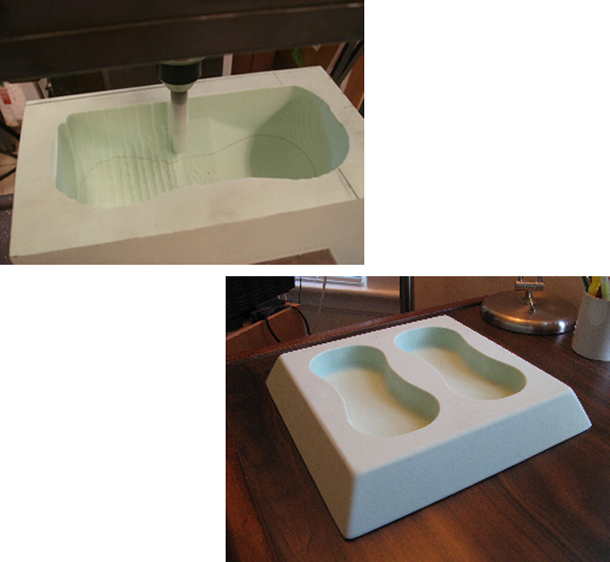
The female molds for vacuum thermoforming were CNC milled from urethane foam. Several shapes were explored through solid modeling and two were chosen for thermoforming. The first version was too deep and caused much unwanted distortion of the spandex fabric along with decreased color saturation. Revision two was half as deep as version one and maintained a flat base to minimize distortion of the spandex fabric while preserving the color as much as possible. Several small 1/16" holes were drilled through the mold to facilitate air evacuation. |
Thermoforming |
|
|
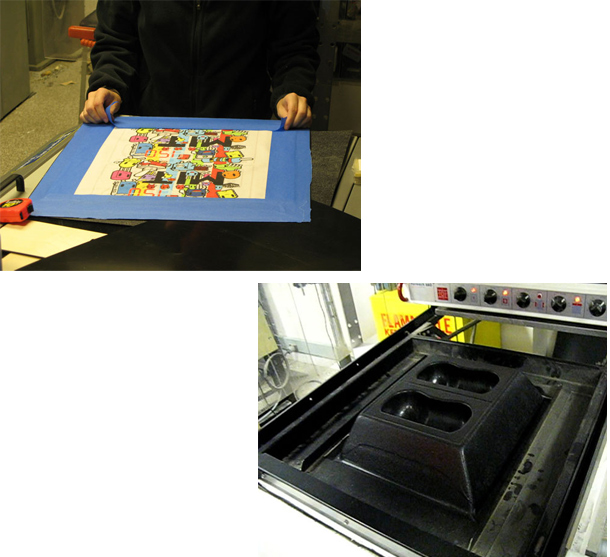
The thermoforming process began by assembling a sandwich of sheet ABS, heat activated adhesive and spandex. The female mold was placed into the machine and the sandwich, fabric side down was placed above. This left the ABS to seal against the vacuum and stretch the spandex against the mold removing all wrinkles. After the formed sandwich cooled and was removed from the urethane mold, it was trimmed with a utility knife and prepared for stitching the zipper to the outside edge.
We have an elaborate video of the thermoforming process here, if you're interested... |
| |
| |