
|



|
Special Effects vibrations : air movement : sound
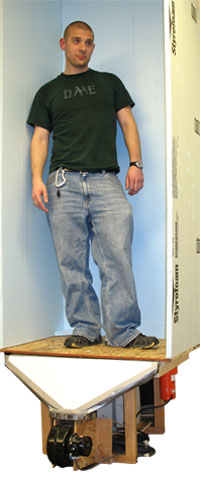
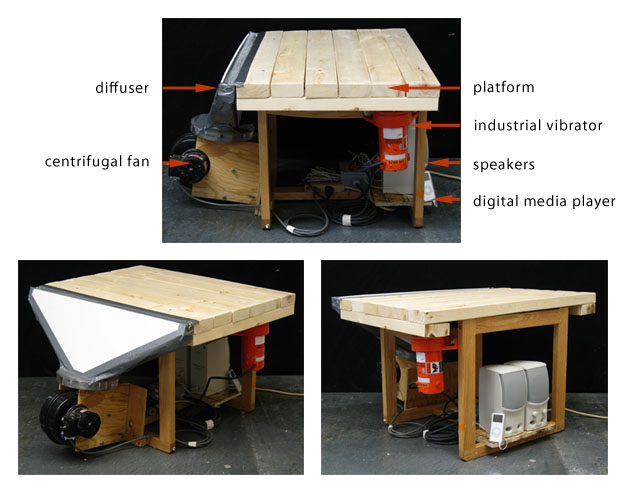
Several effects are necessary to replicate elevator motion. This sketch model focuses on the simulation of steady state conditions in a service elevator. While initial acceleration and final deceleration effects produced by hydraulics may fool the occupant into believing that the elevator is starting or stopping, at constant velocity the only sensation felt by the occupant is vibration. Sound and, in elevators with grated doors, air flow add to the occupant's perception of motion. This model artificially creates the sensations of vibration, sound, and air movement to convince guests that they are in an elevator. |
 |
Sketch Model Apparatus
|
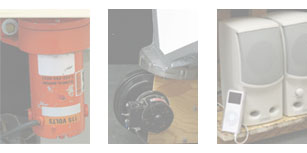
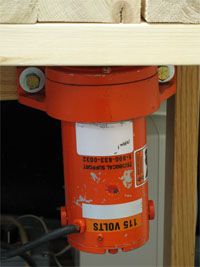
Industrial Vibrator An industrial vibrator was attached to the wood platform base to simulate the vibrations of the service elevator as it travels between floors. Often, vibration is the only sensation that informs occupants that the elevator is moving. (Next time your in an elevator, especially a newer one, pay attention to the vibration of the floor.) To achieve a subtle vibration, a 115V vibrator was set to 20V. Trial by a number of occupants indicated that higher voltages were less elevator-like and, at times, uncomfortable for occupants. |
|
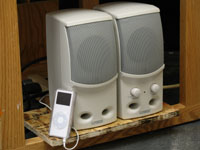
Audio Setup Gated service elevators are noisy. Audio from the service elevator in Building 3 was recorded and played back using a digital audio device and speakers mounted below the platform. Click "Elevator Audio" to hear the audio file used in this sketch model. This audio file was recorded as the service elevator traveled between two floors. The file captured the elevator sounds in real time and was not manipulated in any way. "Elevator Groove" provides a more relaxed audio environment.
|
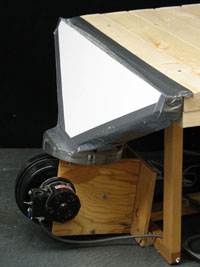 |
Centrifugal Fan and Diffuser Because the service elevator has gated doors, air will flow through the elevator as it travels down the shaft. To simulate this effect, a centrifugal fan was mounted below the platform. Multiple fan types and orientations were tested in the lab. However, fans with lower flow rates went unnoticed by elevator occupants. The best fan, and the one used in the final sketch model, is 1 hp/ 40 cfm. Since most occupants could not feel the air flow on their lower bodies, the air was focused on their upper bodies by mounting the fan was 10 degrees off vertical. A foam core diffuser was attached to the fan to provide a more even lateral distribution of air. In the final prototype a fan will be mounted below the doors at either end of the elevator. |
A Few Thoughts
The sketch model showed that vibration and audio are the most convincing service elevator effects. When properly implemented, air movement contributes to the simulation, but was not essential. Both the fan and the vibrator generate a considerable amount of noise. However, this noise, and the noise produced by the acceleration simulation and scrolling wall will augment the audio track, provided they remain at or below the volume levels observed in our sketch models.
Overall, the model was very successfully in simulating the steady state motion of a service elevator. For the final prototype the fan should take up less space below the elevator, since the elevator location has severe volume constraints. Also, the ducting of the fan should provide a more even lateral distribution of airflow. Speakers should be fixed at several locations below the floor and near the ceiling to produce a more convincing audio effect.