Second Annual MIT-Cambridge Quantum Information Workshop
 Official Web
Page Covering All Events
Official Web
Page Covering All Events 
Contact: Timothy F. Havel
Official Web
Page Covering All Events | DATE & TIME |
9:00 – 10:30 AM | 10:30 AM – Noon | 2:00 – 3:30 PM | 3:30 – 5:00 PM |
|---|---|---|---|---|
| Mon. Jan. 27TH |
D. Kuan Li Oi,
Quantum Maps ... |
C.
Doran, Applications of Geometric Algebra to Quantum Physics |
||
| Tue. Jan. 28TH | C.
Barnes, Inside Quantum Devices |
A. Kent, Topics in Quantum Cryptography |
Y. Suhov &
T. Voice, Entanglement in Large Quantum Systems |
|
| Wed. Jan. 29TH | M. Saracenos,
Quantum Maps ... |
|||
| 6:00 – 9:00 PM WEDNESDAY JANUARY 29TH IN BLDG E-52 | ||
|---|---|---|
| Reception at the MIT Faculty
Club |
||
| 8:30 AM –
12:30 PM THURSDAY JANUARY 30TH
IN ROOM 1-390 |
||
| TIME |
MIT
GROUP LEADER |
QUANTUM INFORMATION RESEARCH OVERVIEW |
| 8:30 am |
Seth Lloyd, Mech. Eng. / RLE | Advances in Quantum Communication |
| 9:00 am |
David Cory & Tim Havel, Nucl. Eng. | Ongoing and Upcoming Experiments in NMR/QIP |
| < Caffeine | Break
> = 9:30 - 9:45 am |
||
| 9:45 am |
Leonid Levitov, Physics | Adiabatic Transport and Entangled States |
| 10:15
am |
Eddie Farhi & Jeff Goldstone, Physics | Speedup by Quantum Walk |
| 10:45
am |
Sanjoy Mitter, EECS / LIDS | Continuous Quantum Measurement |
| < Caffeine | Break > = 11:15 - 11:30 am | ||
| 11:30
am |
Terry Orlando, EECS / RLE |
Time-Ordered Measurements of the Two-States in a Niobium Superconducting Qubit |
| 12:00 pm | Jeff Shapiro & Franco Wong, EECS / RLE |
Long-Distance
Quantum Communication: Architecture and Entanglement Sources |
| 12:30 – 2:00 PM THURSDAY JANUARY 30TH IN BLDG E-52 | ||
| Lunch at the MIT Faculty
Club |
||
| 2:00 – 6:00 PM THURSDAY JANUARY 30TH |
||
| Laboratory
Tours (to be Arranged Individually over Lunch) |
||
| EVENING OF THURSDAY JANUARY 30TH |
||
| MIT People
Take Cambridge People out to their Favorite Local Restaurant &/or Pub |
||
| 8:30 – 11:30 AM FRIDAY JANUARY 31ST
IN ROOM 1-390 |
||
| Collective
Brain-Storming Session (Caffeine Continuously Provided) Based on What We Learned Yesterday, What Can We Do for One Another in the Future? |
||
| 11:30 AM – 1:00 PM FRIDAY JANUARY 31ST |
||
| Chance to
View Posters in 1-242 & Continue Brain-Storming on a One-to-One
Basis (Refreshments Served) |
||
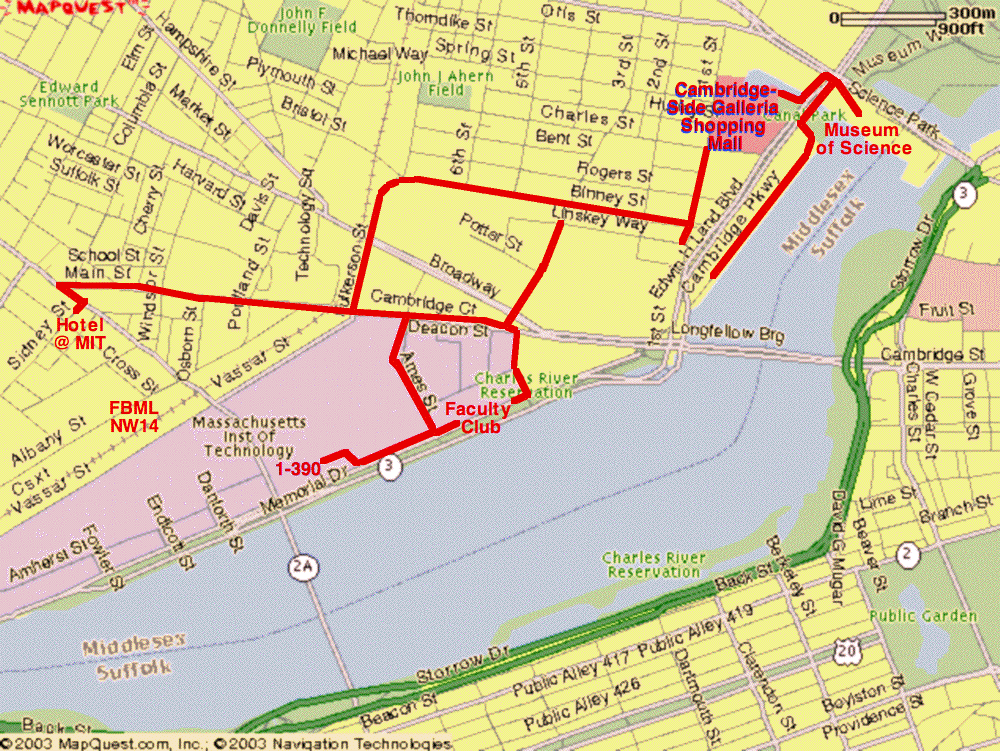
| 1:30 – 3:30 PM FRIDAY JANUARY 31ST (PDF of MAP of WAYS to go...) |
||
| Visit the Exhibits at the Boston Muesum of Science (Recommendation: The
Computing Revolution) |
||
| 3:30 – 5:30 PM FRIDAY JANUARY 31ST |
||
| Early Dinner
in Skyline Room at the Museum of Science |
||
| 5:30 – 6:30 PM FRIDAY JANUARY 31ST |
||
| Laser Show
at the Museum of Science (Tickets Provided) |
||
| REST OF THE EVENING FRIDAY JANUARY 31ST |
||
| Everybody
Does Exactly What They Want (Suggestions: Hang out in the Science Cafe; See "Mysteries of Egypt" in the Omnimax Theater; See "Stars of the Pharaohs" in the Planetarium; Or take the tram downtown and ...) |
||
We will describe some of our ongoing and upcoming measurements on
simple quantum information processors based on NMR. These include:
We will discuss the continuous time quantum walk and show how it
achieves speedup over classical random walks. We will also give an
example of an oracular problem which requires exponential time for any
classical algorithm but which can be solved in polynomial time by
quantum walk [Childs et al., 2002].
In this talk I provide a model for continuous quantum measurement
which leads to a Nonlinear Schroedinger-like equation describing the
evolution of the quantum system under the action of continuous quantum
measurements.
Measurements have been done on a superconducting persistent current
qubit in the classical thermal activation regime and in the quantum
regime. The superconducting qubit has states of equal and opposite
circulating current. The resulting magnetization signal is read out by
ramping the bias current of a DC SQUID magnetometer. This ramping causes
time-ordered measurements of the two states, where one measurement of
one state occurs before the other. This time-ordering results in an
effective measurement time. Thermal activation measurements which
exploit this effective measurement time reveal that the quality factor
for the superconducting junctions are about a million, a value favorable
for the observation of long coherence times at lower temperatures.
Measurements at lower temperatures show the quantization of energy
levels in these qubits.
This work is supported in part by the AFOSR grant F49620-01-1-0457
under the DoD University Research Initiative on Nanotechnology (DURINT)
and by ARDA.
We will describe the basic architecture of a long-distance,
high-fidelity quantum teleportation system based on
polarization-entangled photons and trapped-atom quantum memories.
Suitable polarization entanglement sources under development will be
discussed.
This work was supported in part by the DoD MURI grant described at this URL,
where numerous references are also available.