 |
Post Class Review of Understanding How Things Work |
|
Summary Of 2.972 Understanding How Things Work
MIT Department of Mechanical Engineering
IAP 1999
Instructor/Author: Martin Culpepper
Date: 02/09/98
|
|
|
|
|
|
|
|
|
|
||
Contents:
Motivation
About the Class
- Workshops
- Labs
- Final Reports
- Tours
- Design Project: External Gear Pump
Results of Student Evaluations
- The Class in General
- MIT Mechanical Engineering Courses
Recommendations For Integration Into Curriculum
- Introduction to Mechanical Engineering
- Integration of Take Apart Sections into Core Courses
MOTIVATION
In the fall of 1998 a student, discouraged by her lack of knowledge about how simple machines work (i.e. toasters,) asked Prof. Such to develop a course in which students could learn "how things work." Prof. Suh asked for a volunteer to teach a "take apart class" in which students would learn how machines work by taking them apart. I volunteered to teach the class because I thought it would be an ideal class in which to address several problems I see in course 2 students. Having worked with a multitude of students at MIT (freshman - graduate students,) I have noticed that their ability to go from the theoretical to the practical is limited because:
1. Most students lack general knowledge about machines and their general components (i.e. much of what they learn has been based on "black boxes")
2. Student need more visualization & communication skills
3. Some students are not confident in applying the theory they have learned
4. Students do not know, nor can they explain what the magnitude of simple physical quantities mean (i.e. what is 0.001"? or is 1000 in-lb of torque a lot or a little for a particular application?)
Some might say that these problems are due to the fact that modern students aren't as interested in engineering and practical application as they once were. I believe a better explanation is that students have less opportunities to learn how things work by disassembling them. For instance, ten years ago, the average person could work on their own car, but with the incorporation of computers and other technologies, this task has become almost impossible for a skilled engineer. In addition, students now spend more time interfacing with computers instead of working with actual "hardware" such as bikes, gears, and bearings. As a result, universities which have been accustomed to receiving students with some background in working with machinery now receive students with little or no knowledge of mechanical elements and machinery. The class, 2.972 Understanding How Things Work, is an attempt to impart this missing knowledge to students and develop their confidence in apply theory to the physical world.
ABOUT THE CLASS
Goals of 2.972
1. Provide students with knowledge of how some machines/machine elements work.
2. Improve students visualization & communication skills
3. Develop student confidence in applying theory they have learned to physical systems and machines
4. Provide students with a "feel" for the magnitudes of physical quantities
In addition, the class was designed as the prototype of an Introduction to Mechanical Engineering class for MIT freshmen. Although designed for freshman, enough flexibility was left to adjust and make the class challenging for more experienced students. For instance, the difficulty of the lab write-ups was changed depending upon the experience and knowledge of the students.
Workshops
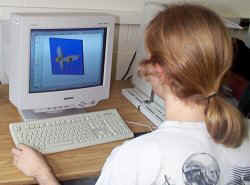
Class time is split between workshops and labs. The workshops (held in a computer room) are used to convey material to the students which enhances the lab experience, prepares them for a design project, and improves their communication skills. For instance in the workshops, the following knowledge and skills are gained:
1. Solid modeling (geometric modeling)
2. Understanding of Functional Requirements and Design Parameters
3. Understanding of the Limiting and Dominant Physics of many machines/stytems/devices
4. Spread sheets (used for performance modeling)
5. Basic sketching
6. Basic web page construction
During the workshops, emphasis is placed on teaching the students that they must understand the following in order to know how things work.
Functional Requirements & Design Parameters
Geometry & Structure
Limiting & Dominant Physics
Flow of material, energy, information, etc..
Labs
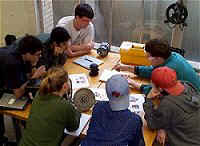
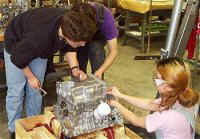
Armed with the knowledge and skill gained in the workshops, students went to lab where they spend the majority of their time taking apart machines. For the first offering of the class, there were four stations dedicated to machines commonly used by engineers:
-Gears and Bearings
-4 Stroke Internal Combustion Engines
-Electro-mechanical Devices
-Positive Displacement Hydraulic Pumps
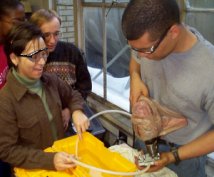
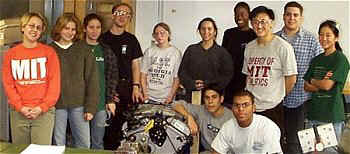
The students were broken into groups of 4, each group spending 2 days at a lab station or table. During the first day, the students took apart a machine which was representative of the other machines at the table. They were guided by a lab write-up which mades certain that they identified the important characteristics of the machine and also guided them through some simple performance models which built their confidence in applying the theory they have learned. In addition, students were asked to sketch each component of the machine and explain how the machine worked. After finishing the write-up, students were free to take apart any other machine at that table. Possessing the knowledge of the physics and geometry of the machine taken apart during the write-up, the students went about figuring out how the other machines worked.
After the 2nd day, the students rotated to the next station. However, before they started work on the lab for the new table, they were responsible for explaining to the group who follows them (in the rotation) how one of the machines at that table worked. This was done "live" with sketches. Since all machines must be put back together before the groups rotated, the students could not "cheat" and use the machines themselves to explain how they worked. The benefit of this activity is that students on the "learning end" asked questions about different parts of the machine and/or its operation. These questions forced the "explainer" to rotate/flip/or otherwise change how he was visualizing the device in his head, then draw another sketch.
Final Reports
Each student wrote a final report on a machine or device which has always interested them. These reports gave the students the opportunity to explore machines which are impractical to take apart in lab. These reports were submitted as web pages which will be collated and used to start the base of an MIT How Things Work Web Site. In each subsequent offering of the class, the database will grow as more reports are added to the database.
Tours
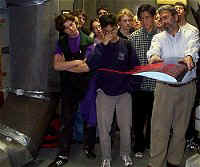
The entire class took tours of the following to help them learn how large systems or systems with several components operate:
• Physical Plant
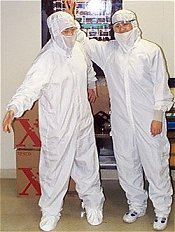
• MEMs Lab
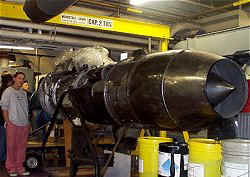
• Wind Tunnel / Jet Engines
• Car Wash (Students hop in a van and are driven through)
Design Project: External Gear Pump
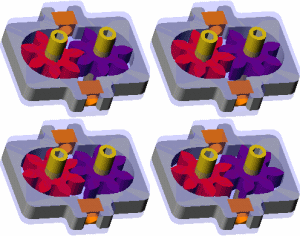
Students designed, solid modeled, manufacture, and ran a simple external gear pump. This project was used to help the students learn solid modeling, which in turn developed their visualization skill. The extent to which this was successful can be viewed in the first section of the student evaluations (appended.) This project also helps students make the link between geometry and its affects on performance. Specifically, students varied critical dimensions of the gear pump and were able to determine the effect of these changes on the performance of the pump.
RESULTS OF STUDENT EVALUATIONS
Students were asked to rate how the class had helped their understanding/skill level with respect to several areas. The averaged responses to the full list of questions is appended for further reading. Copies of the actual evaluations (25 evaluations) can be made available upon request.
What follows are questions which were picked to show the degree to which the goals of the class were accomplished. Ideally, a rating of 5 would be desired.
The Class in General
Very little help <- 1 2 3 4 5 -> A lot of help
Ability to figure out how unfamiliar machine work:
4.5
Develop a physical understanding for magnitudes (i.e. torque, power, size):
4.3
The ability to visualize in 3D
4.0
The ability to explain things to others with simple sketches
4.2
MIT Mechanical Engineering Courses
Students were asked to provide feedback on several courses taken by average course 2 students. For each course, the students were asked to evaluate:
a. How much they learned
b. Confidence in their ability to use what they had learned
c. Whether or not the class would benefit by devoting some time to a take apart section
The responses can be seen in the appended material under the heading MIT MECHANICAL ENGINEERING COURSES.
Of most interest to this discussion is the third question. The response (see appended) indicates that students feel all of the courses listed could benefit from integrating a take apart section (i.e. a few weeks dedicated to taking apart several machines.) Note that the responses indicate that the addition of these sections is higher for classes in which students are expected to build, or learn to build machines.
Recommendations for Integration Into the Mechanical Engineering Curriculum
Introduction to Mechanical Engineering
When considering the student evaluations and discussions held with several students, it appears the best way to enhance the curriculum with this sort of class is to develop it into a semester long class (or seminar) which serves as an introduction to Mechanical Engineering. In doing so, the department will ensure that students entering the curriculum have some experience with machinery. This class can also be used to develop students communication skills, alleviating some of the burden for doing this in later classes. When informally questioned, many students agreed that this would make a great introductory class.
Integration of Take Apart Sections into Core Courses
Another way to use this class is to integrate short take apart sections into the core courses. For instance, in 2.001/2.002, students could disassemble machines that had failed and determine how/why they failed. Or, in 2.005/2.006, students could disassemble pumps, turbines, or other pertinent machinery. These experiences will make what the students learn "more real" to them than drawing black boxes on the board.