









| Background: |
Electroluminescent lighting (EL) was chosen to create the lighting effect for the scan.
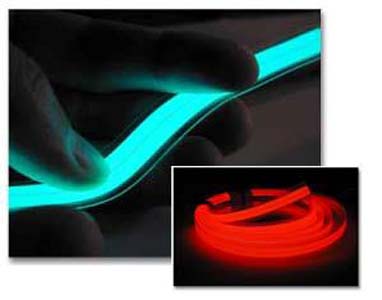
Electroluminescence is defined as the conversion of electric energy to light energy by a solid phosphor subjected to and alternating electric field. An organic phosphor is contacted by two electrodes. When an AC signal of sufficient voltage and frequency is applied across the electrodes, an electric field excites the phosphor causing it to emit light. The power supply required to run EL lights is an inverter which takes DC power from a battery and converts it to AC voltage. EL technology can take the form of wires, panels or strips. They project a uniform, directional glow similar to neon but with greater flexibility. In dimly lit environments, EL lights provide an impressive lighting effect
|
Characteristics
of electroluminescent lighting: |
||
| Placement: |
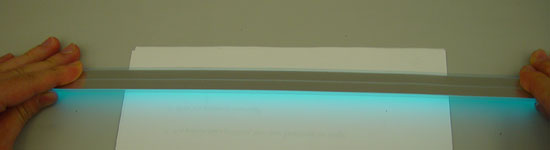
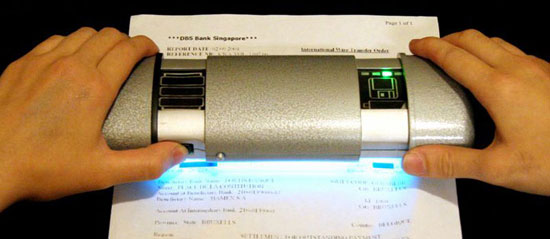
For the scanner application, EL light in the form of a long strip was chosen. Since the glow emitted from EL lights is directional, placing the lights parallel to the surface being scanned prevented the light from spreading out and being seen. An angled placement for the lights near the edge of the scanner was chosen so users could see the spread of light onto the document during the scan.