Dennis G. Whyte
Hitachi America Professor of Engineering
whyte@mit.edu
617-253-1748
NW17-288
Plasma Science & Fusion Center
SPARC
Plasma Surface Interactions Science Center

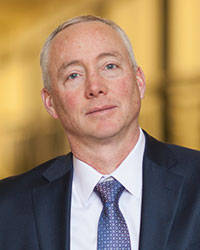
Hitachi America Professor of Engineering
whyte@mit.edu
617-253-1748
NW17-288
Plasma Science & Fusion Center
SPARC
Plasma Surface Interactions Science Center
A recognized leader in fusion research, especially in the magnetic confinement of plasmas, Whyte has paved an innovative and faster path to producing fusion energy. He leads the fusion project, SPARC — a compact, high-field, net fusion energy fusion device — in collaboration with private fusion startup Commonwealth Fusion Systems (CFS). The core of the SPARC project was formed over eight years ago during a design course led by Whyte to challenge assumptions in fusion. Many of the ideas underpinning the high-field approach — including the use of HTS for high-field, demountable magnets, liquid blankets, and ARC (a fusion power plant concept) — have been conceived of or significantly advanced in his design courses. Whyte has over 300 publications, is a fellow of the American Physical Society, and has served on panels for the National Academies, the United States government, and the Royal Society. In 2018 Whyte received The Fusion Power Associates (FPA) Board of Directors Leadership Award which is given annually to individuals who have shown outstanding leadership qualities in accelerating the development of fusion. Whyte earned a BS from the University of Saskatchewan, and an MS and PhD from Université du Québec.
PhD U. Québec 1993
MSc U. Québec 1989
BEng U. Saskatchewan 1986
Magnetic Fusion Energy: Boundary plasma physics, advanced plasma confinement regimes in tokamaks, plasma diagnostics, mitigation of disruption damages
Plasma-Surface Interactions: basic physics of plasma-material interfaces, dynamic measurement techniques for material evolution under plasma bombardment, implications of plasma-surface interactions in magnetic fusion reactors
Accelerators and Surface Analysis: low-energy nuclear scattering techniques for material analysis and damage, development of in-situ surface diagnostic methods for magnetic fusion
22.62 Fusion energy
22.63 Fusion Technology
22.01 Introduction to Nuclear Engineering and Ionizing Radiation


Massachusetts Institute of Technology
77 Massachusetts Avenue, 24-107 (map)
Cambridge, MA 02139
nse-info@mit.edu