
News Archives : 2013

|
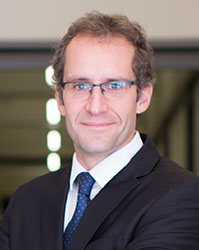
A physicist, an athlete, and an engineerNSE senior Margo Batie plays hard on the rugby field and works hard in the physics lab.
Studying both physics and nuclear science and engineering at MIT is no small challenge, but it’s just one of the activities that senior Margo Batie juggles. During her time at MIT, Batie has played on the varsity basketball team, led the women’s club rugby team, conducted research at two national laboratories, and helped strengthen minority support systems and outreach programs. Born and raised in South Central Los Angeles, Batie was encouraged to pursue engineering by her father, an educator and entrepreneur. “He started an Internet service providing company, so I ran around with him and helped him fix computers when I was younger,” Batie remembers. On weekends in elementary school, she would practice typing and arithmetic, surprising her teacher and classmates when she sped through both in classroom exercises. ...more |
|
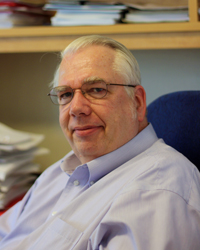
Magnetic nanoparticles could aid heat dissipationParticles suspended in cooling water could prevent hotspots in nuclear plant cooling systems and electronics.
Cooling systems generally rely on water pumped through pipes to remove unwanted heat. Now, researchers at MIT and in Australia have found a way of enhancing heat transfer in such systems by using magnetic fields, a method that could prevent hotspots that can lead to system failures. The system could also be applied to cooling everything from electronic devices to advanced fusion reactors, they say. The system, which relies on a slurry of tiny particles of magnetite, a form of iron oxide, is described in the International Journal of Heat and Mass Transfer, in a paper co-authored by MIT researchers Jacopo Buongiorno and Lin-Wen Hu, and four others. ...more |
|
‘Hybrid’ nuclear plants could make a dent in carbon emissionsCombining nuclear with artificial geothermal, shale oil, or hydrogen production could help slow climate change, study shows.
Many efforts to smooth out the variability of renewable energy sources — such as wind and solar power — have focused on batteries, which could fill gaps lasting hours or days. But MIT’s Charles Forsberg has come up with a much more ambitious idea: He proposes marrying a nuclear powerplant with another energy system, which he argues could add up to much more than the sum of its parts. Forsberg, a research scientist in MIT’s Department of Nuclear Science and Engineering, describes the proposals in a paper published in the November issue of the journal Energy Policy. Now may be just the time for such new approaches, Forsberg says. “As long as you had inexpensive fossil fuels available for electricity demand, there was no reason to think about it,” he says. But now, with the need to address climate change, curb greenhouse gas emissions, and secure greater energy independence, creative new ideas are at a premium. While nuclear plants are good at producing steady power at relatively low cost, their output cannot rapidly be ramped up and down. Meanwhile, renewable energy sources are also good at producing power at low operating cost, but their output is unpredictable. Fossil fuel plants can easily be switched on or off as needed, but have higher operating costs and produce greenhouse gas emissions. One solution, Forsberg suggests, is to find a way to divert excess power from a nuclear plant, making it a “dispatchable” source of electricity — one that can easily be ramped up and down to balance the disparities between production and demand. |

|
MIT receives $5M to develop new methods for detecting shielded nuclear materialsA research collaboration led by MIT has received a 5-year $5M grant from the National Science Foundation and the Domestic Nuclear Detection Office of the Department of Homeland Security to study new approaches to the detection of shielded nuclear material. The approach proposed by MIT involves a new method for producing monoenergetic gamma rays which can penetrate materials and can clearly differentiate between ordinary materials and special nuclear materials (SNM) such as uranium, while reducing the radiation dose by a factor of 20 relative to previous approaches. ...more |
|
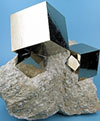
Probing the surface of pyriteCommon mineral gets first detailed examination of its surface electronic properties, thanks to team of MIT researchers.
Pyrite — perhaps better known as “fool’s gold” for its yellowish metallic appearance — is a common, naturally occurring mineral. It holds promise as a high-tech material, with potential uses in solar cells, spintronic devices and catalysts, but is also a byproduct of corrosion of steel in deep-sea oil and gas wells. Both its potential usefulness in devices and its role in corrosion are largely influenced by the fundamental electronic properties of its surface — which have remained relatively unexplored. But a team of MIT researchers has now found a way to probe these elusive surface properties for the first time. Their findings are reported in the journal Surface Science, in a paper by professors Bilge Yildiz and Krystyn Van Vliet and graduate students F. William Herbert and Aravind Krishnamoorthy. ...more |

|
NSE’s Scott Kemp on North Korea's nuclear programNew study suggests that the secretive rogue state may have found a way to circumvent international controls on nuclear materials.
For years now, the chief strategy for curtailing North Korea’s ability to build more nuclear weapons has entailed attempts to block access to critical technologies needed by its nuclear program. But R. Scott Kemp, an assistant professor of nuclear science and engineering at MIT and director of its recently formed Laboratory for Nuclear Security and Policy, has found evidence — by combing through publicly available sources — that the secretive state may have managed an end-run around those restrictions, enabling it to build centrifuges and other equipment needed to produce weapons-grade uranium. The findings were presented this week at a conference in South Korea by Kemp’s collaborator on the project, Joshua Pollack, a Washington-based security consultant. MIT News asked Kemp about how the new study was conducted and the significance of its findings. ...more |
|
PSFC’s Petrasso receives Edward Teller MedalRichard D. Petrasso, head of the High-Energy-Density Physics (HEDP) Division of the MIT Plasma Science and Fusion Center (PSFC), received the 2013 Edward Teller Medal for his division’s work in inertial confinement fusion and high-energy-density physics. Petrasso supervises a number of NSE students, including Chikang Li who is now Associate HEDP Division Head. ...more |
|
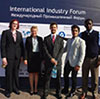
NSE student delegation heads to RussiaA year after the first delegation of MIT Nuclear Science and Engineering students traveled to Russia, a second group headed off to Russia in July 2013 with the goal of strengthening connections between U.S. and Russian students in the nuclear field. This year, 5 students — Gordon Glober (UG), Alexandre Guion (G), Lauren Merriman (UG), Jude Safo (G) and the trip organizer, Katia Paramonova (UG), spent a week and a half in Russia. As Lauren Merriman put it, the trip “opened my eyes to the fact that Russians and American aren’t all that different from each other!”. ...more |
|
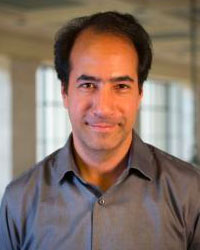
Jasanoff to co-direct MIT's Center for Neurobiological Engineering“Reverse-engineering the brain” is one of the National Academy of Engineering’s Grand Challenges for the 21st Century, and last spring President Barack Obama renewed the call for more advanced neurological research by launching the “BRAIN” initiative. While a number of MIT researchers and faculty have been pursuing these goals for some time, the Institute has now launched a new center to help synergize their efforts. The Center for Neurobiological Engineering (CNBE) will connect the efforts of researchers from approximately 20 labs across campus, as well as faculty from more than a dozen academic departments, institutes and other units. ...more |
|
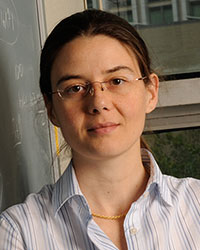
Cappellaro appointed as Edgerton Career Development ProfessorNSE Associate Professor Paola Cappellaro has been appointed to an Esther and Harold E. Edgerton Career Development Professorship for a three-year term commencing July 1, 2013. ...more |

|
Incoming NSE grad student Fischer awarded NSF FellowshipIncoming NSE graduate student Noah Andersen Fischer has been awarded an National Science Foundation’s Graduate Research Fellowship. Fischer will join the Computational Reactor Physics Group (CPRG) in the Department. He will work with Professors Kord Smith and Benoit Forget on advanced computational methods for high performance computing simulations applied to nuclear reactor design and analysis. ...more |
|
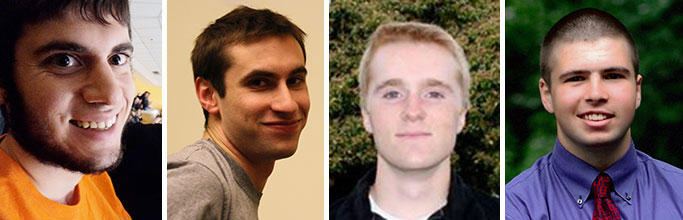
NSE’s Pantano, Richenderfer, Walsh, Kindfuller win NEUP awardsFour students in the Department of Nuclear Science and Engineering have received NEUP awards. Michael Pantano, Andrew Richenderfer and Jonathan Walsh are among 31 graduate students across the nation who were awarded 2013 NEUP fellowships. NSE’s Vincent Kindfuller received an undergraduate NEUP Scholarship. |

|
NSE alum invents device to tap wine bottles without pulling the corkNSE alum Greg Lambrecht’s (SB ’90) wine cellar contains about 1,500 bottles. “I don’t know how many of them are still full,” he said, chuckling. It is hard to tell because Lambrecht drinks from the bottles without removing the corks. That way, he can enjoy just one glass at a time from a costly bottle, and then wait as long as he wants before tasting it again. It is a neat trick, and Lambrecht, an MIT-trained nuclear engineer and founder of Intrinsic Orthopedics Inc., a Woburn medical device company, has spent the past decade mastering it. Now he is going to share his innovation with other affluent wine buffs, at $300 a pop. |

|
NSE team finds new nuclear fuel-rod cladding could lead to safer power plantsA substitute for traditional zircaloy could greatly reduce the danger of hydrogen explosions.
In the aftermath of Japan’s earthquake and tsunami in March 2011, the Fukushima Daiichi nuclear plant was initially driven into shutdown by the magnitude 9.0 quake; its emergency generators then failed because they were inundated by the tsunami. But the greatest damage to the complex, and the greatest release of radiation, may have been caused by explosions of hydrogen gas that built up inside some of the reactors. That hydrogen buildup was the result of hot steam coming into contact with overheated nuclear fuel rods covered by a cladding of zirconium alloy, or “zircaloy” — the material used as fuel-rod cladding in all water-cooled nuclear reactors, which constitute more than 90 percent of the world’s power reactors. When it gets hot enough, zircaloy reacts with steam to produce hydrogen, a hazard in any loss-of-coolant nuclear accident. A team of researchers in NSE is developing an alternative that could provide similar protection for nuclear fuel, while reducing the risk of hydrogen production by roughly a thousandfold. Tests of the new cladding material, a ceramic compound called silicon carbide (SiC), are described in a series of papers [1|2] appearing in the journal Nuclear Technology. ...more |

|
NSE team finding the keys to boiling heat transferUnderstanding the properties that control surface dissipation of heat could lead to improved power plants and electronics with high heat-transfer rates.
A team of MIT researchers has succeeded in carrying out the first systematic investigation of the factors that control boiling heat transfer from a surface to a liquid. This process is crucial to the efficiency of power plants and the cooling of high-power electronics, and could even lead to improvements in how vehicles travel through water. The research deals with a key transition point known as the critical heat flux, or CHF, a value of heat transfer, per unit time and area, where a surface’s heat-transfer characteristics suddenly change: For example, when the cooling panels of an electronics system become covered with a layer of vapor that blocks heat transfer, the resulting rise in temperature can damage or destroy the equipment. The new findings could raise the value of CHF, providing extra safety margins or operating ranges for such equipment. ...more |
|
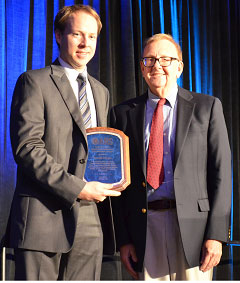
Benoit Forget wins 2013 Landis Engineering Achievement Award from the American Nuclear SocietyAssociate Professor of Nuclear Science and Engineering Benoit Forget has won the American Nuclear Society’s 2013 Landis Young Member Engineering Achievement Award. This prestigious award recognizes significant technical contributions by an individual under the age of 40. Forget received the award for his “outstanding contributions in revitalizing the MIT Department of Nuclear Science and Engineering and developing efficient, scalable Monte Carlo reactor physics analysis tools." ...more |
|
MIT Student Section of ANS honored at Annual MeetingMIT’s ANS Student Section received the Samuel L. Glasstone Award Honorable Mention at the opening plenary of the ANS Annual Meeting. The Student Section was recognized for organizing and hosting the 2013 ANS Student Conference at MIT — the most successful and largest ANS Student Conference to date. Established in 1969 the annual award recognizes outstanding ANS Student Sections for “the most notable achievements in public service and the advancement of nuclear engineering.” It is administered jointly by the Student Sections Committee (SSC) and the Education, Training and Workforce Development Division (ETWDD) of the ANS. |

|
NSE’s Dewan discusses a new way to do nuclear with The New YorkerIn February of 2010, Leslie Dewan and Mark Massie, two MIT students, were sitting on a bench in a soaring marble lobby under the university’s iconic dome. They had just passed their PhD qualifying exams in nuclear engineering, ...more |
|
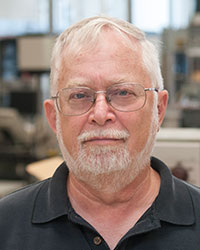
NSE’s Ballinger appointed to NRC Advisory Committee on Reactor SafeguardsThe Nuclear Regulatory Commission has appointed Professor Ronald Ballinger to the Advisory Committee on Reactor Safeguards (ACRS) for a four-year term. Ballinger is a professor of nuclear science and engineering and also materials science and engineering and is head of the H.H. Uhlig Corrosion Laboratory at the Massachusetts Institute of Technology. His areas of specialization are materials selection, nuclear engineering systems, environmental degradation, and life assessment of these systems. In addition to the courses he has taught at MIT, Professor Ballinger has also developed and has taught several industrial courses on environmental degradation with EPRI and the Materials Aging Institute. ...more |

|
Meet our 2013 graduates...more |
|
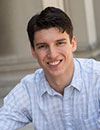
Jake Jurewicz: Meeting the Challenge of Nuclear EnergyStudying Energy at MIT means many things to many students. For some, it means urban planning or ocean engineering. For others, it means nuclear physics or climate science.
When Jake Jurewicz ’14, a nuclear science and engineering major, first came to MIT he had his sights set on studying nuclear fusion – the “Holy Grail,” he says, of energy sources because of its ability to produce a constant, clean supply of electricity. But it didn’t take long for Jurewicz to broaden his focus. His studies at MIT include not only developing and improving nuclear technology, but also the social and political issues that can present barriers to expanded use of nuclear energy. “The nuclear industry struggles not from a lack of new ideas or engineering solutions, but from a means of implementing them,” Jurewicz says. “Politicians, social groups, and regulatory agencies are constantly changing and expanding their demands of nuclear energy.” ...more |

|
Diving into nuclear policyWhether he’s in a Navy submarine or in Washington, you’ll find MIT senior Cameron McCord at the intersection of nuclear engineering, policy and service.
If you ask MIT students where they see themselves in a few years, you’ll get a wide range of answers — but almost all will be on dry land. MIT senior Cameron McCord feels a different calling: the ocean deep. A physics and nuclear science and engineering major from Springfield, Va., who is part of the Naval Reserve Officer Training Corps (NROTC) at MIT, McCord will spend at least five years as an officer in the U.S. Navy after graduating. A commitment to service is typical for NROTC students, but McCord is taking the road less traveled by being selected for submarine service. “A submarine is basically an engineer’s dream, because it’s a completely isolated nuclear powerplant that’s on its own underwater,” explains McCord, a 2012 Truman Scholar. “Submarines are awesome; I always sort of geek out when I’m talking about them.” ...more VIDEO: Today MIT, tomorrow the world: Members of the Class of 2013 tell their story watch |
|
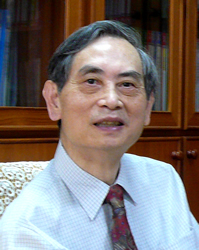
Sow-Hsin Chen Distinguished Lectureship in Neutron Science and Technology launched in TaiwanThe inaugural Sow-Hsin Chen Distinguished Lectureship in Neutron Science and Technology at Taiwan’s National Tsing Hua University (NTHU) was delivered on May 22, 2013 by Professor John M. Carpenter of Argonne National Laboratory. The Lectureship is named after Emeritus Professor Sow-Hsin Chen, who is internationally known for his contributions to the understanding of both fundamental and practical aspects of material science using neutron scattering techniques. ...more |
|
NSE’s Shaner wins Heller Entrepreneurship GrantNSE graduate student Sam Shaner was one of four students recently awarded the Ronald I. Heller Entrepreneurship Grant by MIT through the Martin Trust Center for MIT Entrepreneurship. The Ronald I. Heller Entrepreneurship Grant is presented annually to a MIT student or group of students for their significant impact on the quality and overall spirit of entrepreneurship at the Institute, working closely with the Martin Trust Center for MIT Entrepreneurship, and for their leadership and entrepreneurial fervor in introducing more students to entrepreneurship. ...more |
|
NSE students graduate from Gordon-MIT Engineering Leadership ProgramFour NSE students were among 59 across the Institute who were awarded Gordon-MIT Engineering Leadership Program Certificates this week. Cameron McCord and Ekaterina Paramonova received Advanced Certificates of Engineering Leadership for successfully completing the requirements of the two-year Bernard M. Gordon-MIT Engineering Leadership Program. Cameron French and Jake Jurewicz earned Certificates of Engineering Leadership for completing their first year in the program. French and Jurewicz will start the second year program in fall 2013. ... more |
|
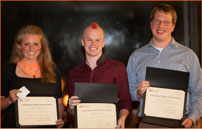
NSE celebrates outstanding students at the Annual Awards DinnerOn May 9, 2013 the Department of Nuclear Science and Engineering and the student chapter of the American Nuclear Society hosted their annual awards dinner. ... more |

|
Innovation and commercialization in nuclear energyOn April 26th, 2013, a group of about 40 experts in nuclear energy technology, energy policy, energy and venture finance, regulation, and philanthropy gathered at MIT in Cambridge, Massachusetts to discuss the challenges and barriers to innovation and commercialization of new nuclear energy technologies and to discuss solution strategies. ... more |

|
NSE-led UPower wins category in MIT Clean Energy Prize, is finalist in MIT 100K competitionThe sixth annual MIT Clean Energy Prize (CEP) competition, held Monday night, awarded a total of $320,000 to five teams that have developed clean-energy startups and innovations. The contest, co-sponsored by Massachusetts utility NSTAR and the U.S. Department of Energy (DOE) and open to teams from any American university, is the nation’s leading student-run energy business-plan competition. Past participants have gone on to raise a total of $130 million in funding. ... more |

|
NSE's Gilman honored at ODGE celebration of women graduate studentsIn April 2013, MIT's Office of the Dean for Graduate Education hosted a celebration of graduate women at MIT. NSE's Lindsey Gilman was one of 47 graduate students who were nominated by their peers, faculty, and staff. The honorees were nominated and selected based on their leadership and service contributions at the Institute, their dedication to mentoring and their drive to make changes to improve student experience. At the celebration, held at the Microsoft NERD Center, honorees presented posters to help attendees: learn about their accomplishments |
|
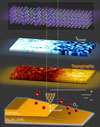
Unleashing oxygen‘Superlattice’ structure could give a huge boost to oxygen reaction in fuel cells, increasing their power potential.
New research at MIT could dramatically improve the efficiency of fuel cells, which are considered a promising alternative to batteries for powering everything from electronic devices to cars and homes. Fuel cells make electricity by combining hydrogen, or hydrocarbon fuels, with oxygen. But the most efficient types, called solid oxide fuel cells (SOFC), have drawbacks that have limited their usefulness — including operating temperatures above 700 degrees Celsius (roughly 1300 degrees Fahrenheit). Now, MIT researchers have unraveled the properties of a promising alternative material structure for a key component of these devices. The new structure, a “superlattice” of two compounds interleaved at a tiny scale, could serve as one of the two electrodes in the fuel cell. The complex material, discovered about six years ago and known as LSC113/214, is composed of two oxides of the elements lanthanum, strontium and cobalt. While one of the oxides was already known as an especially good material for such electrodes, the combination of the two is far more potent in promoting oxygen reduction than either oxide alone. The interfaces between these two oxides were thought to be the key. But until now, no one had been able to observe the LSC113/214 interface properties in operation, at sufficiently high resolution, to figure out why it worked so well. ... more |

|
Understanding the turbulence in plasmasNew experiments in a tokamak fusion reactor reveal details of a cooling process, potentially bringing practical fusion closer.
A longstanding joke holds that practical fusion power is about 20 years away — and always will be. One simple phenomenon explains why practical, self-sustaining fusion reactions have proved difficult to achieve: Turbulence in the superhot, electrically charged gas, called plasma, that circulates inside a fusion reactor can cause the plasma to lose much of its heat. This prevents the plasma from reaching the temperatures needed to overcome the electrical repulsion between atomic nuclei — which, in turn, prevents those nuclei from fusing together. But in order to tame that turbulence, scientists first must understand it. Researchers at MIT’s Plasma Science and Fusion Center (PSFC) have now taken a significant step in that direction by quantifying a previously unknown type of small-scale turbulence that can have big effects on cooling the plasma in a reactor. Their results were published online in the journal Physics of Plasmas, and further described in a recent talk at a conference called the U.S.-E.U. Joint Transport Task Force Workshop. ... more |

|
Changing the face of the nuclear engineerStudents of nuclear science and technology learned from experts in the field, presented their unique research, and captured on video what it means to be a nuclear scientist or nuclear engineer last week at the 2013 American Nuclear Society Student Conference. The first ever “I’m a Nuke” videos will be featuring nuclear science and technology students from across the world who participated in the conference hosted by the Massachusetts Institute of Technology Student Section of the American Nuclear Society. The conference theme was the Public Image of the Nuclear Engineer. This was based on the conflicting views of the nuclear industry which many continue to hold. Although nuclear energy is safe, clean, and reliable, it has many obstacles in convincing the public of its successes. ... more |
|
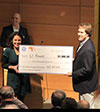
NSE-led teams sweep Future Energy @ MIT pitch competitionOn April 4 three NSE-led teams took the top prizes in a Boston-area pitch competition focused on finding radical new solutions to the world’s energy challenges. The pitch contest, Future Energy @ MIT, was convened by Ultra Light Startups, an organizer of pitch events, with MIT partners the MIT Energy Club and the MIT Clean Energy Prize. The event featured eight energy and clean-tech startups from Boston-area schools presenting to a panel of venture capital and corporate investors. ... more |

|
Watching fluid flow at nanometer scalesResearchers find that tiny nanowires can lift liquids as effectively as tubes.
Imagine if you could drink a glass of water just by inserting a solid wire into it and sucking on it as though it were a soda straw. It turns out that if you were tiny enough, that method would work just fine — and wouldn’t even require the suction to start. New research carried out at MIT and elsewhere has demonstrated for the first time that when inserted into a pool of liquid, nanowires — wires that are only hundreds of nanometers (billionths of a meter) across — naturally draw the liquid upward in a thin film that coats the surface of the wire. The finding could have applications in microfluidic devices, biomedical research and inkjet printers. The phenomenon had been predicted by theorists, but never observed because the process is too small to be seen by optical microscopes; electron microscopes need to operate in a vacuum, which would cause most liquids to evaporate almost instantly. To overcome this, the MIT team used an ionic liquid called DMPI-TFSI, which remains stable even in a powerful vacuum. Though the observations used this specific liquid, the results are believed to apply to most liquids, including water. The results are published in the journal Nature Nanotechnology by a team of researchers led by Ju Li, an MIT professor of nuclear science and engineering and materials science and engineering, along with researchers at Sandia National Laboratories in New Mexico, the University of Pennsylvania, the University of Pittsburgh, and Zhejiang University in China. ... more |
|
Bringing a Star to Earth for Energy: Dennis Whyte at TEDxBeaconStreetOur lives revolve entirely around electricity. Dennis Whyte, a Professor of Nuclear Science and Engineering at MIT, has a vision for how we can consume energy in a cleaner, nearly limitless way. It’s called magnetic fusion — the same process that keeps our sun and stars burning bright. To recreate that power, a group of researchers at MIT are working to bring a star to earth — that is, they’re engineering a device that uses powerful magnetic fields and advanced superconductor materials. It’s not science fiction, it’s happening right now at the MIT Plasma Science and Fusion Center in Cambridge, MA. In this future-facing TEDxBeaconStreet talk, Dennis Whyte talks through the development of a revolutionary energy device that can change our world in a very big way. . ... watch video |
|
NSE ranked #1 in the country by U.S. News and World ReportExtending a decades-long run, MIT’s graduate program in engineering has again been ranked No. 1 in the country by U.S. News & World Report. MIT has held the top spot since 1990, when the magazine first ranked graduate programs in engineering. U.S. News awarded MIT a score of 100 among graduate programs in engineering, followed by No. 2 Stanford University (95), No. 3 University of California at Berkeley (87), and No. 4 California Institute of Technology (78). MIT’s graduate programs led U.S. News lists in seven engineering disciplines, up from four No. 1 rankings last year. Top-ranked at MIT this year are programs in aerospace engineering (tied with Caltech); chemical engineering; materials engineering; computer engineering; electrical engineering (tied with Stanford); mechanical engineering (tied with Stanford); and nuclear engineering. Other top-five graduate programs at MIT include industrial/manufacturing/systems engineering (No. 3, tied with Northwestern University, Stanford and Berkeley) and biomedical engineering (No. 5). ... more |
|
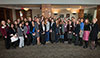
NSE Rising Stars symposium offers young women researchers rare opportunityThere was a profound sense of fellowship in the room March 5th when a dozen outstanding young women researchers gathered at MIT for the Rising Stars in Nuclear Science and Engineering Symposium. Of all the engineering disciplines, nuclear science and engineering might be the loneliest for women, with just 228 female graduate students and 13 postdoctoral fellows pursuing the field at the National Science Foundation’s last count. This forum, organized by the Department of Nuclear Science and Engineering, provided a singular opportunity for women on the verge of launching their careers in the discipline to share research and connect with each other and with established academics and practitioners. ... more |
|
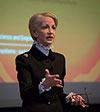
Advice for nations pursuing nuclear power: Lady Barbara Judge delivers 12th Rose LectureLady Barbara Judge has a unique global perspective on nuclear power, combining top-level financial and legal experience with oversight and advisory roles in nuclear energy efforts in the UK, United Arab Emirates, Japan, and elsewhere. As MIT NSE’s twelfth David J. Rose Lecturer, she shared insights into the many challenges facing nations trying to start or maintain nuclear power programs, while noting that, even in a post-Fukushima world, fission has an essential role in “keeping the lights on for our families, our children, and the two billion people in the world who have no electricity at all. ” ... more |

|
NSE students in the national spotlightNSE graduate students Leslie Dewan and Mark Massie, and alum Robert Petrowski were names to the Forbes 30 under 30 rising stars in the energy sector. Seniors Cameraon McCord, Ekaterina Paramonova, and Ethan Peterson were names to the Business Insider 14 most impressive students at MIT list.... more |
|
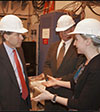
Lawmakers focus on MIT fusion researchThree members of Congress visited the Plasma Science and Fusion Center (PSFC) last week to learn more about fusion research, and to understand the importance of MIT’s Alcator C-Mod tokamak to the national and world fusion effort. On Wednesday, January 30, U.S. Rep. Joseph Kennedy III (D-Mass.) and U.S. Rep. John Tierney (D-Mass.) received separate tours of the C-Mod control room and cell, guided by PSFC Director Miklos Porkolab, Associate Director Martin Greenwald and Alcator Project Head Earl Marmar. U.S. Sen. Tom Udall (D-N.M.) toured the lab on Friday, February 1. Kennedy, Tierney and Udall learned about fusion energy and the current status of the Alcator Project, which would cease operation under the Department of Energy’s Presidential 2013 budget guidance. They discussed fusion’s potential importance to national security, its value to the economy and its advantages as a green technology. ... slideshow |
|
In the war against climate change, look to the statesBoston Globe op ed by Richard K. Lester, January 27, 2013
Nature's signals are changing American minds about the risks of climate change. But Washington’s minds are lagging, despite President Obama’s stirring call to action in his inaugural speech. The best hope for achieving the transition to a low-carbon economy is through innovation to reduce the costs of new energy technologies. Energy markets left to themselves will discount climate-change risks, so public action to encourage these innovations is needed. But public action does not mean putting government agencies at the center of the innovation system. Instead, the focus should be on unlocking the immense creativity and resources of America’s private entrepreneurs, investors, producers, and energy users. The debate in Washington on how to do this has featured two and a half ideas — from Democrats, Republicans, and economists. The economists’ big idea has been to attach a price to carbon emissions. That idea has intellectual merit but lacks congressional support. And it would only be a partial solution. ... download pdf |


Department of Nuclear Science & Engineering
Massachusetts Institute of Technology
77 Massachusetts Avenue, 24-107 (map)
Cambridge, MA 02139
nse-info@mit.edu